Moving Estimates
How to Get an Accurate Moving Estimate: What Movers Actually Need
Published
Learn what movers need for an accurate estimate, including furniture, boxes, access and services. Use our free inventory tool and pre-estimate checklist.
A moving estimate is a priced description of your move. Before a moving company can give you a useful written estimate, it needs to understand what you're moving, where it's going, how hard your home is to get in and out of, and which services you want.
The more accurate that description is, the easier it becomes to compare estimates, spot missing services, and avoid preventable surprises on moving day.
You don't need to know how to calculate shipment weight, truck space or crew hours. That's the estimator's job. Your job is to give them the right information — and here's how to have all of it ready before you request your first quote.
What information do movers need for an estimate?
Six categories. Their relative importance varies from move to move:
- What's moving — furniture, appliances, boxes and specialty items that will physically be loaded, and what's staying behind
- Where it's going — both addresses, or a note that the destination isn't settled yet
- When — your date and how much flexibility you have
- Access at both ends — stairs, elevators, parking, how far the carry is
- Services — who packs, what needs disassembly, whether storage or a second stop is involved
- Special handling — items that don't move like ordinary furniture
Square footage and bedroom count aren't on that list. They're what a web form asks for to produce a fast number, and similarly sized homes can hold materially different shipments depending on what's in the garage, the closets and the storage unit.
Build your inventory before you request estimates
Go room by room, and treat the spaces outside the main living area as a separate pass: garage, attic, basement, closets, patio, shed. An off-site storage unit is easy to leave off for a simple reason — it isn't in the home you're standing in when you make the list.
For each room, record:
- Furniture, as individual pieces rather than as a "set"
- Appliances, and whether they're coming with you
- Boxes, by room — both packed and still to come
- Specialty items — anything heavy, oversized, fragile or awkward
- What's staying — sold, donated, going in your car, or left behind
That last line is information, not an omission. A mover who doesn't know the dining set is being sold may plan and price for it.
Describe your belongings the way an estimator needs to understand them
An estimator converts your words into truck space, weight, labor time and materials. Words that don't convert cleanly become assumptions, and assumptions are where the gap between the estimate and the invoice opens up.
| What the customer says | What helps the estimator | Why the difference matters |
|---|---|---|
| "A couch" | A three-piece sectional, sections detach, plus a separate ottoman | Clarifies how many pieces need handling and how much truck space they take |
| "The bedroom" | Bed frame, mattress and box spring, dresser, two nightstands | Replaces an ambiguous "set" with countable items |
| "Some gym equipment" | A treadmill, an adjustable bench, weight plates | Flags unusual weight, dimensions and possible disassembly |
| "A desk" | An L-shaped desk with a separate glass top | Identifies a fragile component that travels differently |
| "Apartment with an elevator" | 4th floor, one service elevator, must be reserved with the building, loading zone roughly 150 feet from the door | Lets the mover assess access conditions and required services |
| "About twenty boxes" | 14 packed so far; roughly 10 more expected from the kitchen and closets | Makes the current count and the projected total distinguishable |
These are illustrative examples, not actual customer cases.
The pattern: name the pieces, note what detaches or needs taking apart, flag anything unusually heavy or fragile, and say plainly what you don't know yet. "I'm not sure" is useful. A guess presented as a fact is not.
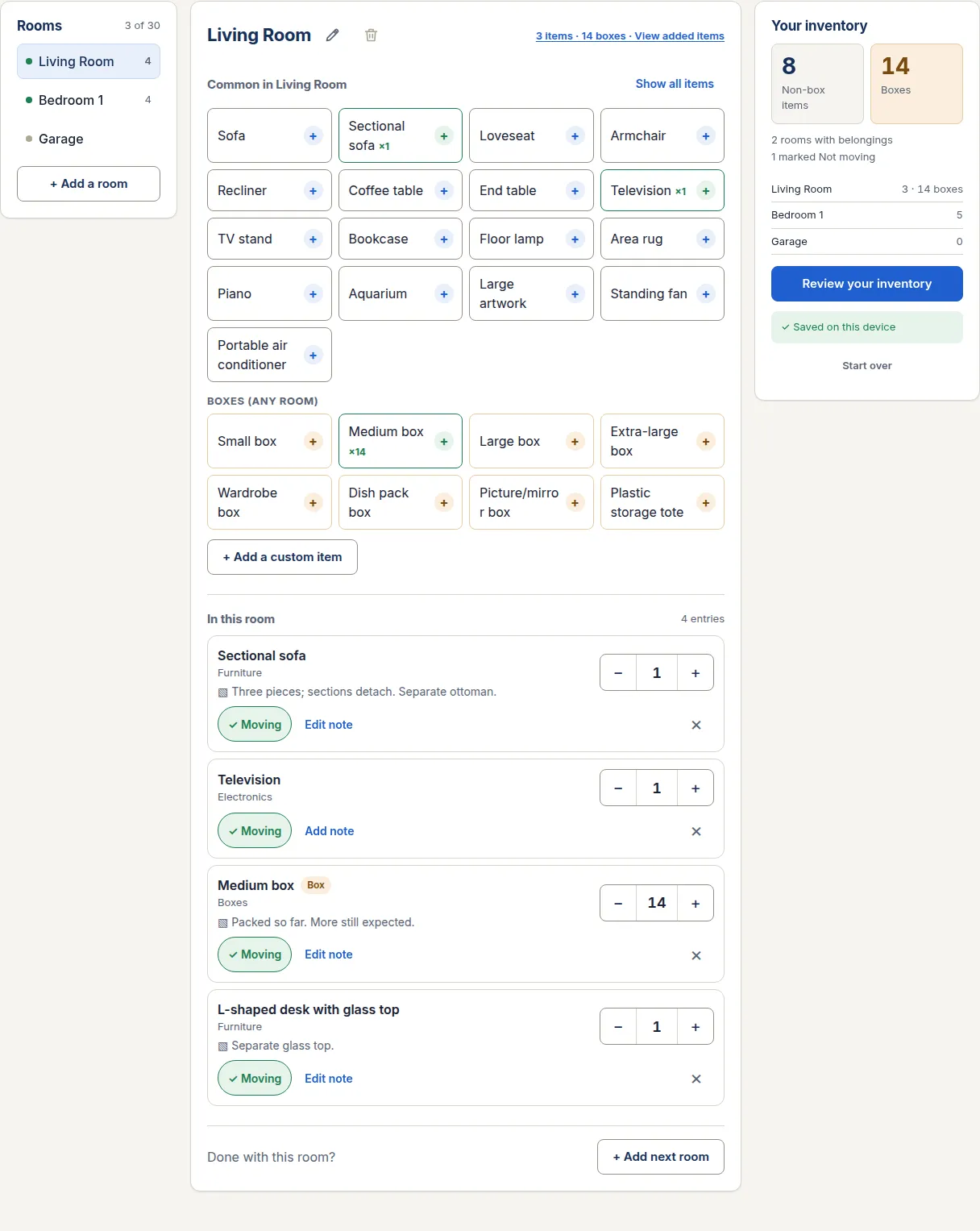
Prepare your inventory before requesting quotes
Organize your belongings by room, record quantities, boxes and notes, and keep one consistent inventory for every moving company you contact. It's free and there's no account to create.
Create your free moving inventory →Do movers have to survey your belongings before giving an estimate?
For interstate household-goods moves, generally yes.
Under 49 CFR §375.401(a), the carrier must conduct a physical survey of the goods to be transported and provide a written estimate based on that survey. A survey doesn't have to happen in your living room: §375.103 defines a physical survey as one conducted on-site or virtually, and specifies that where it's performed virtually the carrier must be able to view the goods through live or pre-recorded video that lets it clearly identify what's being transported.
A video walkthrough that meets these requirements counts as a physical survey. An audio-only phone conversation or text-only web form does not.
You can waive the survey, but the waiver has to be deliberate: under §375.401(a) it must be in writing, signed before your shipment is loaded, and retained by the carrier as an addendum to the bill of lading.
Two things this does not mean. A preliminary price range given over the phone is not necessarily a regulatory violation, but it does not replace the required written estimate. And your own inventory is not a substitute for the carrier's survey. It's a preparation and communication aid: it helps you show the right things on a video walkthrough, and it helps you describe your shipment consistently if you do choose to waive the survey.
One note on older sources: you may still see a 50-mile exception to the survey requirement quoted on legal aggregator sites and in older CFR editions. The current §375.401(a) text does not contain it.
For local and intrastate moves, these federal rules don't apply — state rules do, and they differ. Ask your local mover whether an in-person or video walkthrough is available.
Report packed and projected box counts separately
If you haven't finished packing when you request estimates, separate your current box count from the number you still expect to pack:
- Packed — boxes that physically exist right now
- Projected — what you still expect to pack
Report both, say which is which, and update the projection as you go rather than once at the end. Additional boxes may affect truck space, labor or planning, and a mover who knew from the start that your figure was partial can account for that.
Two things to avoid. Don't count a box and its contents twice as separate shipment pieces — a sealed carton of books is one carton. You can still document valuable or fragile contents. Keep furniture separate from your box count.
Document access at both locations
Access affects labor, equipment and logistics, and it's easy to stop noticing your own stairs.
Worth stating for both the origin and the destination:
- Floor number, and whether there's an elevator
- Whether the elevator must be reserved, and any building time windows
- Where a truck can legally park, and how far that is from the door
- Narrow driveways, low clearances, gates, tight turns, permit requirements
- Stairs inside the home, not just at the entrance
- Whether the destination is unknown, or storage is involved
Here's the part consumers rarely hear: this isn't solely your responsibility. Under §375.401(f), the carrier must determine charges for accessorial services such as elevators and long carries before preparing the bill of lading. If it fails to ask you about those charges and fails to determine them before preparing the bill of lading, the regulation requires it to deliver the goods and bill you after 30 days for the additional charges.
The practical takeaway: raise access early, and ask the mover to confirm in writing which access-related services are included and how they're charged. Don't leave it to be discovered when the truck is at the curb.
Confirm which services are included
Differing assumptions about included services can lead to unexpected charges and disputes. Depending on the mover and your agreement, each of these may be included, charged separately, or not offered at all:
- Packing — all of it, none of it, or a split (they do the kitchen and fragile items, you do the rest)
- Materials — cartons, paper and tape
- Disassembly and reassembly — beds, sectionals, wall units, exercise equipment, TV mounts
- Appliance servicing — washers, refrigerators, anything needing disconnection
- Extra stops — a storage unit, a relative's garage, a second pickup
- Storage in transit, and for how long
- Valuation — the level of carrier liability you select, which is distinct from separate insurance. See FMCSA’s valuation and liability guidance.
Ask which are in the quote and which aren't, and get the answer in writing.
Request written estimates you can actually compare
If you're collecting multiple estimates, describe your shipment identically to each company — same inventory, same box counts, same access details, same services. Add the patio furniture after the first call, and you need to go back and tell that company too. Otherwise you aren't comparing three prices for one move; you're comparing three prices for three slightly different moves, and an incomplete inventory can make an estimate look cheaper without making it better value.
For covered interstate household-goods moves, 49 CFR §375.401(h) requires both you and the mover to sign the written estimate and the mover to provide you with a dated copy at signing.
Two things to understand about what you'll receive. A binding estimate guarantees the total cost of the move based on the quantities and services shown on it. A non-binding estimate is what the mover believes the total will be, based on estimated weight or volume plus the services requested; for covered interstate moves, final charges under a non-binding estimate are based on actual shipment weight and the applicable tariff.
For covered interstate moves, the 110 percent rule is not a cap on your final bill. Under 49 CFR §375.703, the maximum a mover may collect at delivery on a non-binding estimate is 110 percent of the estimated charges, plus charges for any additional services you requested after the bill of lading was issued, plus any applicable impracticable-operations charges defined in the carrier’s tariff — and that last category is separately limited to 15 percent of the other charges due at delivery. Remaining charges are billed afterward.
Your pre-estimate readiness checklist
Before requesting and finalizing your estimates:
- Inventory built, including garage, attic, basement, closets and outdoor areas
- Off-site storage and any second pickup location accounted for
- Both addresses confirmed, or the destination flagged as unsettled
- Date and flexibility settled
- Access documented for both locations, including elevator rules
- Packing responsibility decided
- Specialty and oversized items identified
- Boxes split into packed and projected
- Survey arranged — in person or by video — or a waiver decision made knowingly
- A written estimate requested from each company, with services itemized
- The same inventory ready to give every company
Already have a list and want to check it for gaps and ambiguities? Ten moving inventory mistakes that can change your quote is the diagnostic pass. Starting from scratch? The room-by-room moving inventory checklist walks through the whole house, or build your inventory in MyMovingRadar and keep it in one place.
This article cites federal regulations that apply to interstate household-goods moves. Local and intrastate moves are governed by state rules, which differ. It is general information, not legal advice. MyMovingRadar is an independent moving inventory and consumer education resource, not a moving company or government agency. Moving services, prices and contractual terms must be confirmed directly with your chosen moving company.