Moving Inventory
10 Moving Inventory Mistakes That Can Change Your Moving Quote
Published
Check your moving inventory for 10 mistakes that can affect your quote, from missing items and box counts to access, packing and inconsistent lists.
A moving inventory can look complete and still leave important questions unanswered. A sectional listed as one couch, a storage unit that never made it onto the list, a box count recorded before packing is finished — each of these changes the information a mover uses to prepare an estimate.
These mistakes don't automatically make your move more expensive. What they do is create a gap between the move you described and the move the company is actually being asked to perform.
Here are ten worth checking before you request or finalize an estimate, why each matters to the mover, and how to correct it.
Why inventory mistakes can affect a moving estimate
A moving company turns your inventory into truck space, weight, crew hours and materials. Where your list is ambiguous, the estimator fills the gap with an assumption. Those assumptions may be reasonable and still be wrong, and an ambiguity may not surface until moving day, when there is less time to adjust the plan.
Reviewing your list before requesting estimates gives the mover more time to clarify the scope.
Overlooked belongings
1. Treating the house as the whole move
Inventories get built by walking the rooms people live in. The garage, attic, basement, closets, patio and shed hold belongings too, and they're often the awkward ones: bikes, tools, paint, sports gear, patio furniture, seasonal bins.
Why it matters to the mover: these spaces tend to contain items that affect materials, packing time and handling. Some of them may not be able to travel on the truck at all. Items such as gasoline, propane cylinders and certain paints may require special arrangements or may not be accepted by your mover — tell the mover about potentially hazardous materials before packing them, and ask which items are prohibited or require separate handling. See FMCSA’s guidance on hazardous household goods.
How to correct it: walk the storage and outdoor spaces as a deliberate second pass, after you think you're finished. Then sort what you find into three buckets — coming with the mover, staying behind, and needing separate arrangements. Our room-by-room checklist covers these areas in detail.
2. Leaving out a second location
A storage unit across town, boxes at a relative's house, a garage you still have keys to. These get left off for a simple reason: they aren't in the home you're standing in when you build the list.
Why it matters to the mover: an additional pickup isn't only more volume, it's another stop. That can affect routing, the crew's day, how the truck is loaded, and whether the shipment can be completed in one trip.
How to correct it: list every physical location your belongings are coming from, including places you intend to empty yourself but haven't yet. If you're not certain you'll clear the unit in time, tell the mover that the additional pickup may be necessary and confirm how that uncertainty will be handled.
Descriptions that don't survive translation
3. Describing furniture without its configuration
"A sectional" might be two pieces or six. "A bed" could be a frame, mattress, box spring and headboard, or a platform with built-in storage drawers. A wall unit might be modular. A dining table might have removable leaves and a separate glass top.
Why it matters to the mover: the configuration drives handling and truck space more than the furniture's name does. A mover may well record a sectional as one furniture item — but it needs to know how many sections, whether they detach, and whether anything travels separately.
How to correct it: you don't need to turn every detachable part into its own inventory line. Name the item, then state its configuration: how many pieces, what comes apart, what's already apart, and what's made of glass or stone.
4. Not identifying items that don't behave like ordinary furniture
Safes, pianos, treadmills, large aquariums, stone or marble tops, oversized artwork, gun cabinets, commercial-grade appliances.
Why it matters to the mover: these may change the plan rather than just adding to it — potentially affecting crew size, equipment, crating, or the approach to a staircase. A mover that learns about the safe on moving day has a scheduling problem, not only a pricing one.
How to correct it: keep a short separate list of anything unusually heavy, oversized or fragile, and give whatever you actually know — known dimensions, a model number, a manufacturer's weight — recording estimates as estimates. Then let the mover determine what handling it requires. Judging weight by whether two people can lift something isn't enough to establish how an item should be moved safely.
Boxes
5. Reporting a projected box count as a finished one
If you haven't finished packing when you request estimates, the number you give is a forecast. The problem isn't that it's a forecast — it's when a forecast gets recorded as a count.
Why it matters to the mover: box quantities feed into truck space and loading time. A mover that knows your figure is partial can plan for that; one that doesn't is working from a number you never meant as final.
How to correct it: report what exists and what you expect, separately.
| Room | Packed | Still anticipated |
|---|---|---|
| Kitchen | 4 | 6 |
| Bedroom | 3 | 4 |
| Living room | 2 | 2 |
| Total | 9 | 12 |
Projected total: 21 boxes.
Hypothetical quantities for illustration — not a recommendation for how many boxes any home needs.
Tell the mover which boxes already exist and which are estimates, then update the projection as packing progresses.
6. Counting the contents and the container
A sealed carton of books is one carton. Listing both the carton and the forty books inside it inflates the shipment and makes the list harder to read. The opposite error is listing a room's contents as individual items when they'll all be boxed, so no box count ever appears.
Why it matters to the mover: an inventory that double-counts doesn't reconcile against what actually loads, which makes any later conversation about discrepancies harder for you, not easier.
How to correct it: once something is in a box, count it as a box, and keep furniture out of the box count entirely. That's about counting shipment pieces — it isn't a reason to stop recording what's in the valuable or fragile cartons. Notes on contents can matter for packing decisions, the valuation coverage you select, and any claim you might need to make later. Count pieces once; describe contents where it's useful.
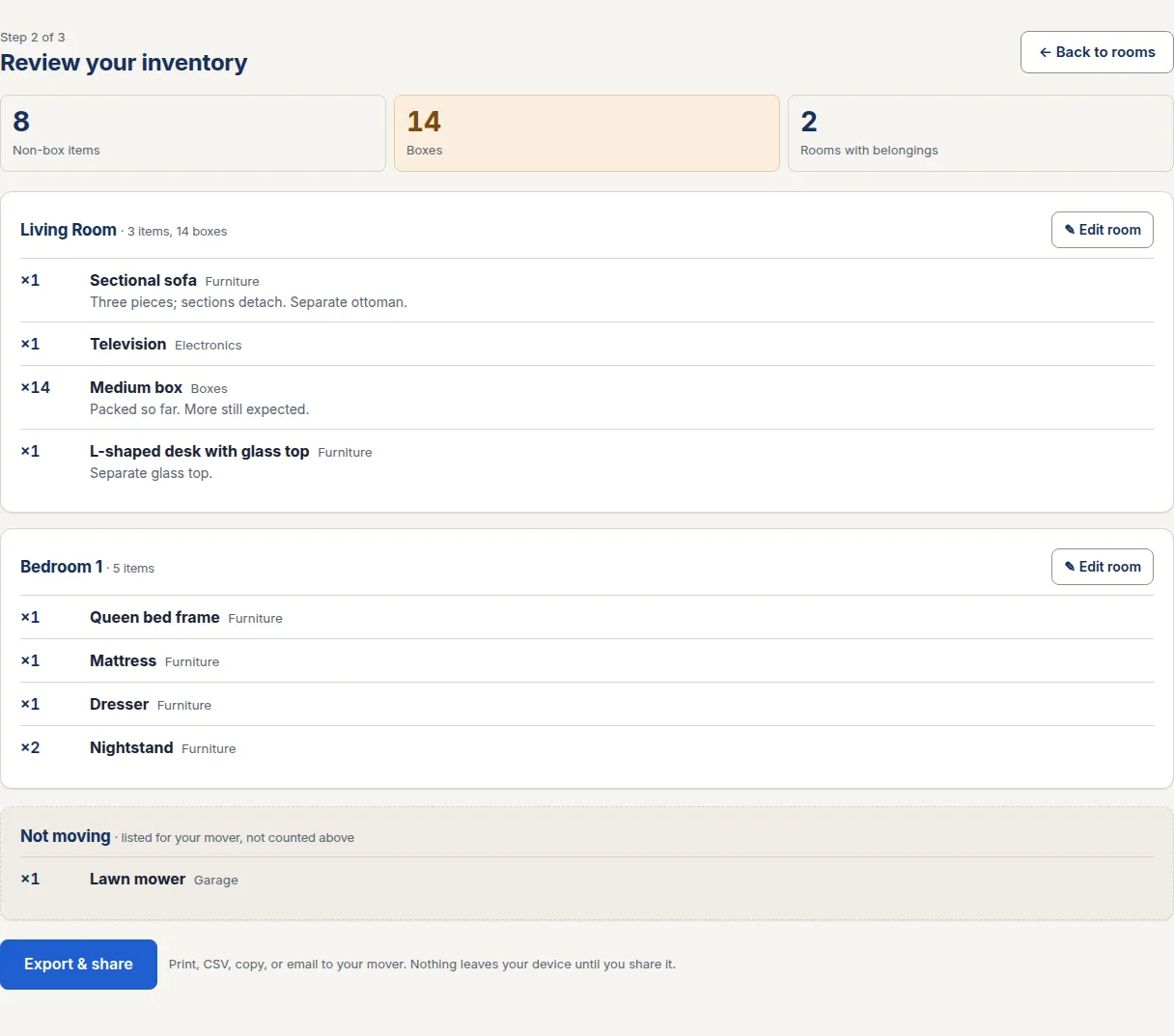
Review and correct your inventory
Organize your belongings by room, record quantities, boxes and notes, and keep one consistent list for every moving company you talk to. It's free and there's no account to create.
Open your moving inventory →Assumptions about services
7. Assuming a service is included
Start with packing. Then disassembly and reassembly, materials, appliance disconnection, TV mounting, crating for artwork or glass, and storage in transit.
Why it matters to the mover: depending on the company and your agreement, each of these may be included in the price, charged separately, or not offered at all. None of that is implied by your inventory.
How to correct it: go through the list explicitly and ask which items are in the quote and which aren't. Get the answer in writing. If you're splitting packing — the mover does fragile items and the kitchen, you do the rest — write down exactly where that line falls.
8. Leaving access out of the inventory
Stairs, elevators, parking distance, gates, narrow driveways, low clearances, permit requirements, building time windows.
Why it matters to the mover: access can affect labor, equipment and logistics. A fourth-floor walkup and a fourth floor with a reservable service elevator contain the same belongings and present different jobs. Elevator reservation rules in particular aren't the mover's to discover — they're the building's.
How to correct it: record access for both addresses alongside your inventory, not as an afterthought, and ask the mover to confirm in writing which access-related services are included and how they're charged. Worth knowing: for interstate moves, 49 CFR §375.401(f) requires the carrier to determine charges for accessorial services such as elevators and long carries before preparing the bill of lading. This isn't solely your responsibility to raise.
Managing the inventory over time
9. Not marking what's staying behind
Furniture being sold, donated, left for the buyer, or going in your own car. An item left on the list without an exclusion may be treated as part of the shipment.
Why it matters to the mover: an inventory that includes items that aren't moving overstates the shipment. On moving day it also means the crew is reconciling a list against a home that doesn't match it.
How to correct it: keep a record of belongings you have decided not to move, and confirm those exclusions with the moving company. If your plans change, update your inventory and tell the mover before the move.
10. Giving different movers different lists
This is the one most worth fixing. You walk the first company through the house, remember the patio set before the second call, and mention the storage unit to the third.
Why it matters: you no longer have three estimates for one move.
| Mover | Information provided | What differs in the comparison |
|---|---|---|
| Company A | Household furniture, appliances, projected boxes | No off-site storage included |
| Company B | The same, plus garage and storage-unit belongings | Larger described shipment |
| Company C | The same as B, plus mover-provided packing | Additional service scope |
Illustrative scenario. No prices implied.
These differences do not, by themselves, establish that any company is doing something wrong. They're pricing three different scopes of work, and comparing their totals tells you very little about which one offers better value.
How to correct it: maintain one inventory and give every company the same version of it. When something changes, update it in one place and tell each company. And if your inventory changes after you've already received an estimate, don't assume the original price or service agreement still reflects the new list — update the inventory, tell the mover what changed, and ask whether a revised written estimate is needed before loading begins. Different rules may apply depending on the estimate type and whether your move is interstate or intrastate.
How to check your inventory before sending it to a mover
Run this once before your list goes out.
Completeness
- Storage and outdoor spaces walked as a deliberate second pass
- Every pickup location listed, including storage units
- Items needing separate arrangements identified and set aside from the shipment
- Items staying behind clearly excluded from the shipment
Accuracy
- Furniture described with its configuration — pieces, what detaches, what's glass or stone
- Unusually heavy, oversized and fragile items on a separate short list
- Estimated dimensions or weights identified as approximate; known model information recorded accurately
Boxes
- Packed and anticipated counts recorded separately, with a projected total
- Nothing counted twice — contents are inside boxes, not alongside them
- Furniture and large items kept out of the box count
- Contents noted for valuable or fragile cartons
Services and access
- Packing responsibility settled and written down
- Disassembly, crating, appliance and storage needs noted
- Access recorded for both addresses, including elevator rules
- Written confirmation requested of what's included and how it's charged
Consistency
- One inventory, the same version given to every company
- A plan for updating it and telling each mover when you do
Preparing for an estimate appointment? How to get an accurate moving estimate covers the whole preparation process. If you’re still building your list, the room-by-room checklist walks the house with you. Or keep it all in one place in MyMovingRadar.
This article explains general practice. The regulatory point cited applies to interstate household-goods moves; local and intrastate moves are governed by state rules, which differ. It is general information, not legal advice. MyMovingRadar is an independent moving inventory and consumer education resource, not a moving company or government agency. Moving services, prices and contractual terms must be confirmed directly with your chosen moving company.